Beyond the Checklist: Proving Food Safety Culture for SQF Edition 10

by Jeff Chilton, CEO & Founder of PEAK Advisors
If you attended my recent presentation at the Food Safety Summit, you know that the landscape
of food safety is undergoing a fundamental shift. We are moving away from a pure compliance
mindset, where success is defined by checking boxes on a clipboard and toward a culture-
driven approach. With the upcoming release of SQF Edition 10 and the updated Global Food
Safety Initiative (GFSI) Position Paper, "Food Safety Culture" (FSC) is no longer just a buzzword.
It is a mandatory, measurable, and critical determinant of your organization's food safety
outcomes. In this post, I want to expand on the key takeaways from my Summit presentation: how to
understand the new requirements, how to measure your culture, and most importantly, how to
bridge the gap between written policies and actual floor behaviors.
What’s New: SQF Edition 10 and GFSI Updates
The regulatory and certification bodies have made their expectations clear. The updated GFSI
Position Paper (March 2026) defines food safety culture as "a concept existing in all food
businesses relating to the deeply rooted beliefs, behaviors, values and assumptions that are
learned and shared by all employees, and which integrate to impact the food safety performance
of the organization" [1].
More specifically, SQF Edition 10 introduces stringent new requirements under sections 2.1.1.2
and 2.1.1.3:
+ Mandatory Culture Building: Site management shall build a positive food safety
culture.
+ Employee Empowerment: All personnel must understand their responsibilities, notify
management of issues, act to resolve them, and demonstrate commitment.
+ Documented Assessment Plan: You must have a documented, implemented, and
maintained FSC assessment plan to drive continuous improvement. This plan must include
communication strategies, comprehensive training, feedback mechanisms, and regular
measurement.
Auditors are shifting their focus from methodology to mindset. They are no longer just looking
at your HACCP plan; they are looking at senior management engagement, the robustness of your
FSC assessment plan, employee engagement levels, and the actual effectiveness of your training.
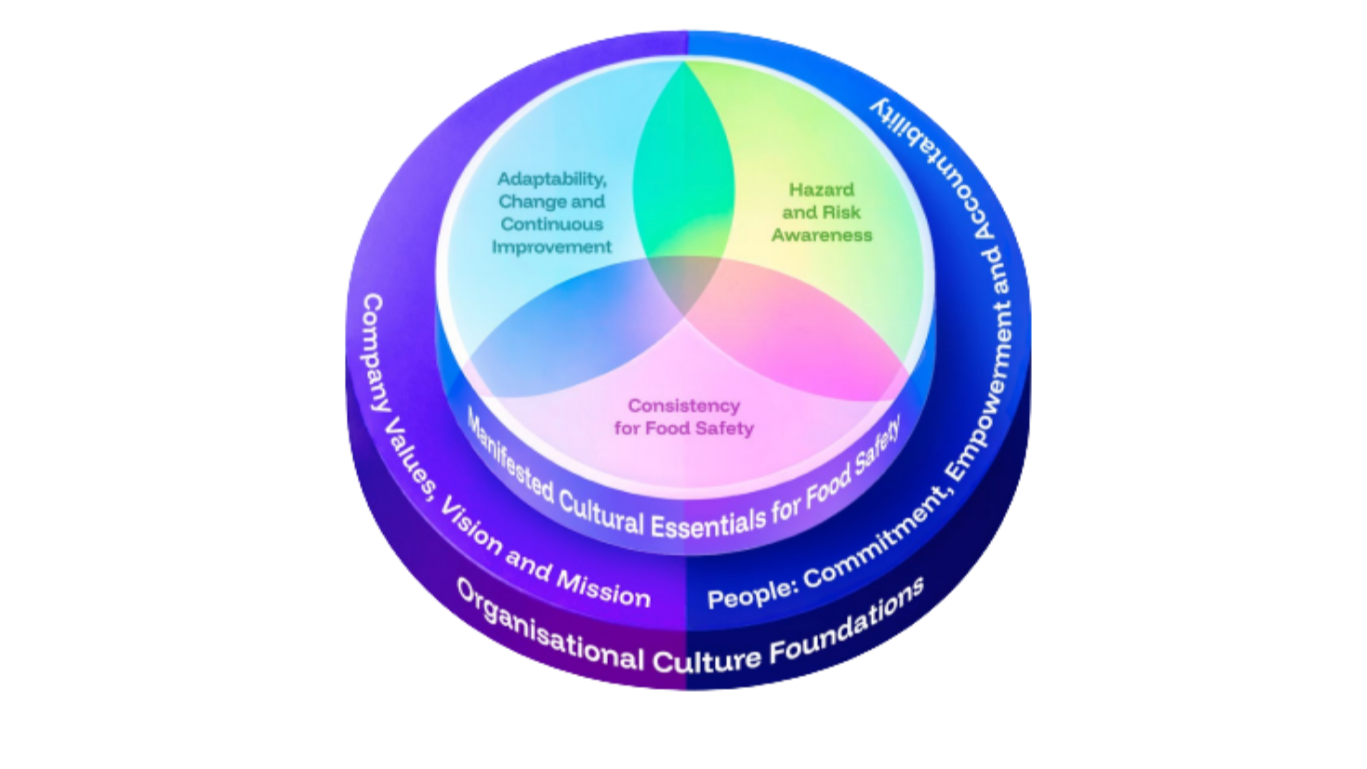
The 5 Dimensions of Food Safety Culture
To build and measure a strong culture, you need a framework. The GFSI outlines five critical
dimensions of Food Safety Culture:
1. Vision and Mission: This encompasses your business structure, values, purpose, and the
direction set by leadership messaging.
2. People: This involves stakeholders, governance, communication, and how you incentivize,
reward, and recognize safe behaviors.
3. Consistency: This is about accountability, performance measurement, and proper
documentation.
4. Adaptability: How agile is your organization? How do you handle change and crisis
management?
5. Hazards and Risk Awareness: This requires foundational hazard information, deep
employee engagement, and the continuous verification of risk awareness.
Measuring the Invisible: How to Quantify Culture
One of the most common questions I get is, "How do we measure culture?" You can't just put a
thermometer in it. However, you can measure the behaviors and outcomes that culture
produces.
1. Employee Feedback Surveys
Surveys are a powerful tool to gauge the current state of your culture. You should be asking
questions across three key areas:
+ Knowledge & Understanding (Do people 'get it'?):: "I understand the main food
hazards for my job."
+ Engagement & Ownership (Do people care and act?):: "If I see a food safety risk, I feel
comfortable speaking up." or "I feel empowered to stop work if I believe food safety is at
risk."
+ Communication & Training Effectiveness (Is the system working?):: "Training helps
me handle real situations I face on the job."
2. Objective KPIs for Continuous Improvement
Beyond surveys, you must track hard data. Here are examples of metrics that reflect the health
of your food safety culture:
Category Example Metrics
+ Operational Controls % of CCP checks completed on time; CCP deviations per 1,000 production hours; PRP compliance scores.
+ Verification & Monitoring Internal audit scores by module; Environmental monitoring trend lines; % of records verified on time.
+ Corrective Action Effectiveness Average time to close CAPAs; % of repeat deviations (recurrence rate).
+ People & Training Post-training knowledge assessment scores; Observation-based behavior compliance; % of critical roles current on training.
Bridging the Gap Between Policy and Behavior
Having a written program is not enough. To truly improve your food safety culture, you must
bridge the gap between what is written in your SOPs and what actually happens on the plant
floor.
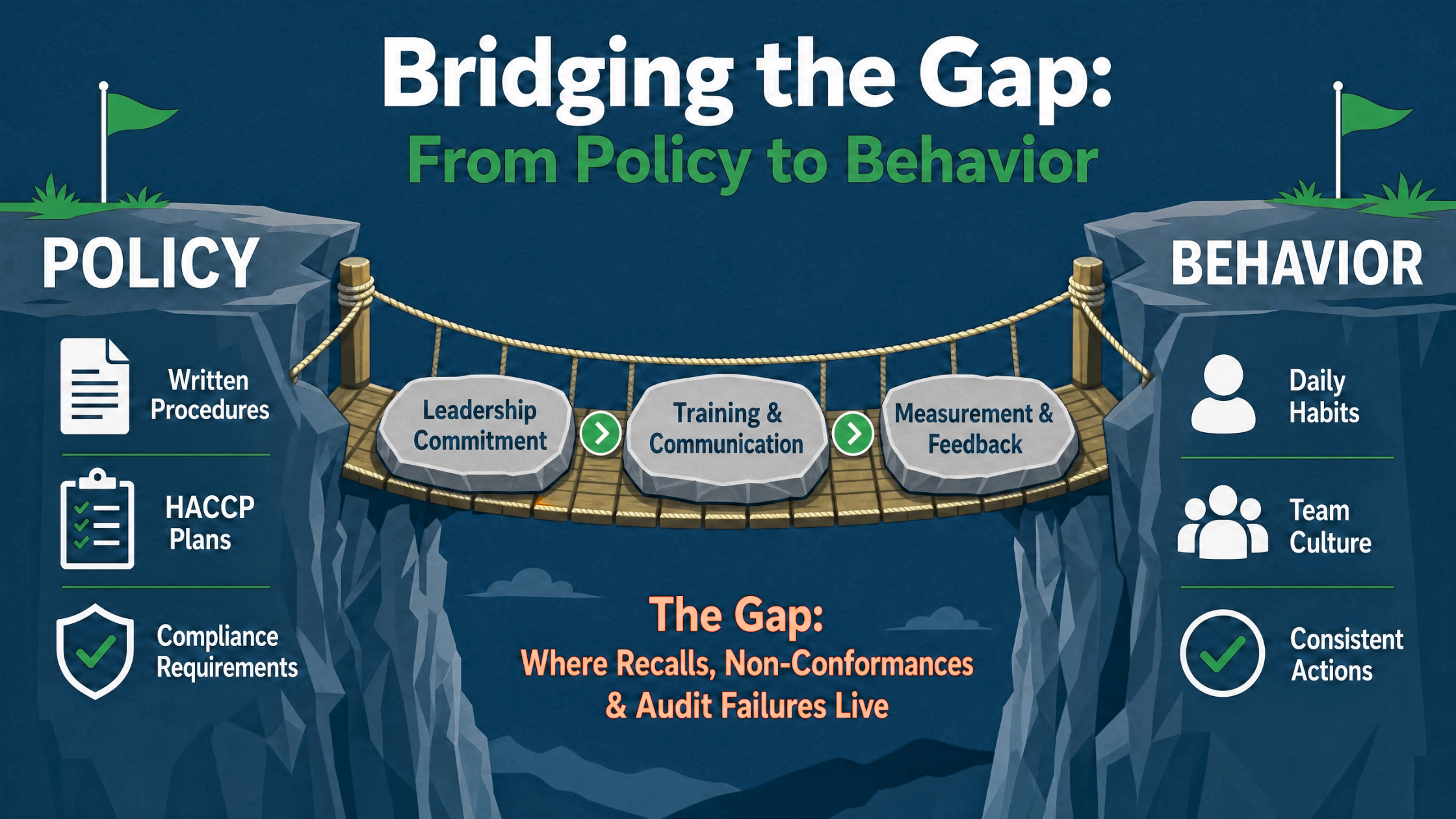
First, you must help employees understand the "Why" behind the tasks they perform. When
people understand the consequences of failure, they are more likely to commit to the right
behaviors.
Second, you must implement robust, two-way feedback systems. Communication cannot just be
top-down from management. You must solicit and respond to employee concerns. Best practices
include recognizing "Food Safety Heroes," using suggestion cards or digital apps for open input,
and conducting regular debriefs on survey results.
Finally, audit your systems to see if they are really working. Use daily inspections, Gemba
Walks, and monthly audits to move your organization from constantly firefighting repeating
problems to making robust, sustainable improvements.
A Framework for Proving Improvement
Proving improvement to an auditor requires a dual approach, focusing on both Management
and Employees:
Management's Role:
+ Demonstrate senior management commitment and engagement at all levels.
+ Maintain a detailed FSC Assessment Plan covering communications, training, feedback, and
measurement.
+ Define and measure the right objectives, and use surveys for quantitative results.
Employees' Role:
+ Demonstrate engagement and routine GMP compliance.
+ Show readiness for auditor interviews.
+ Engage in peer-to-peer support and accountability.
Key Takeaways
The transition to SQF Edition 10 is an opportunity to elevate your entire operation. My advice to
you is simple:
+ Start Now, Be Ready! Do not wait for the final code release to begin working on your culture.
+ Measure & Improve! Establish your baselines now so you can demonstrate continuous
improvement to your auditor.
+ Train and Communicate! Invest in effective training platforms, that allow
you to verify competency in real-time and ditch the pen and paper.
At Peak Advisors, we specialize in helping food manufacturers build the strategic frameworks
necessary to thrive under these new standards. If you are ready to move beyond the checklist,
let's talk.